
Greetings from Yorkshire!
As I always say, you can’t beat a nice, quiet start to the year. Ease your way back into things after a couple of weeks with your family, wrestling with nothing more complex than the morality of stealing segments of your three-year-old’s Chocolate Orange, one at a time, on the grounds that she probably shouldn’t be allowed to eat all of it anyway.
Or, alternatively, you could follow the Premier League’s lead and do, well, the exact opposite. We were about 12 hours into 2026 when Chelsea relieved Enzo Maresca of his duties. We hadn’t even managed a week when Manchester United decided they’d had enough of Ruben Amorim, too, dismissing the Portuguese after 14 months of his three-year contract.
I’m writing to you when the year is precisely seven days old. Chelsea is now managed by Liam Rosenior. Manchester United is apparently discussing restoring Ole-Gunnar Solskjaer to the wheel. There’s a decent chance that West Ham will be looking for a new manager soon, too. 2026 is going to be one of those years, isn’t it?
📬 Enjoying The Correspondent? Check Out Our Other MiB Newsletters:
🐦⬛ The Raven: Our Monday and Friday newsletter where we preview the biggest matches around the world (and tell you where/how to watch them) and recap our favorite football moments from the weekend.
☀️ The Women’s Game: Everything you need to know about women’s soccer, sent straight to your inbox each week.
🇺🇸 USMNT Only: Your regular update on the most important topics in the U.S. men’s game, all leading up to this year’s World Cup.
End of the Line 👋

In hindsight, Ruben Amorim’s first instinct was the correct one. Over the next few weeks, as he reflects on the first – spectacular – failure of his managerial career, as he tries to piece together exactly where his time at Manchester United went wrong, he may even find some comfort in that. He knew, from the start, that it wouldn’t work.
It seems a long time ago, given all that has happened, but to recap: Manchester United first approached Amorim in the fall of 2024. He was, at that stage, the brightest young coach in Europe. To United’s relatively freshly-installed sporting leadership – minority owner Sir Jim Ratcliffe, chief executive Omar Berrada, technical director Jason Wilcox – Amorim looked like just the dynamic, charismatic coach they needed to reinvigorate the club.
Except he said no. He was made an offer everyone assumed he could not refuse, and turned it down. Well, sort of: more accurately, he said not yet. He would prefer, he said, to see out the season at Sporting CP, hopefully claim a third Portuguese title, and then take charge at Old Trafford in the summer. He would need a full pre-season, he thought, to drill the players in his system.
Quite what made him change his mind is not entirely clear. It may have been money; that can’t be ruled out. It seems more likely to me, though, that it was fear. Amorim had made a blistering start to management. He was sufficiently confident in his ability, at least initially, that he assumed United would be prepared to wait for him.
But all managers, like players, know how volatile the world in which they operate can be. They know that some opportunities do not come round more than once. It is that, more than anything else, that explains why so many players continue to sign contracts at Chelsea. Everyone in soccer understands how fragile the future can be. Amorim, too. When United told him he had to make a choice, his worry got the better of him. He took the job.
And it worked out as he had known it would, deep down, right from the start. His system, the one he vowed he would never abandon, did not look like it suited his players at the start, in the middle, or even at the end. It is just about possible that there was some improvement over time – although his 32% win ratio does not suggest as much – but it was fractional, slender, almost indistinguishable to the naked eye.
It is hard to remember a manager whose job felt so precarious for so long. Amorim could easily have been fired last January, back when he was busy telling people his United team was the worst in the club’s history. He could easily have been fired in May, when the stoppable force of his side ran into the moveable object of Ange Postecoglou’s Tottenham Hotspur and lost, locking United’s backdoor into the Champions League in the process.
He could – and to be honest, probably should – have been fired in September, when United crashed out of the Carabao Cup to Grimsby Town. Not simply for the fact of the result, but for the iconography of it: Amorim fretting over a tactics board as everything fell apart before his eyes; Amorim frozen in terror as the penalty shootout unfolded.
By that stage, it had long felt like the Portuguese would have found dismissal a blessed relief. For as long as he had been under pressure, he had given off the distinct impression that he would not really mind being put out of his misery. There is a sort of unspoken rule among managers – or head coaches, whatever it says on their contracts – that you do not really talk about being fired. You flip the question, insisting to everyone that you have the full support of the club. You do not want to put ideas in anyone’s heads, after all. You do not want to manifest anything.
Amorim, by contrast, talked about it openly, freely, consistently. More than once, he almost seemed to invite it, proving his own power by challenging his employers to do something he (presumably) know they did not want to do. Maybe that was it. Maybe he is just a fatalistic type. Maybe he had realized very quickly how this was going to end. Or maybe he had known, on some level, from the start.
The manner of his downfall, certainly, casts Amorim’s surprisingly laissez-faire approach to pressure in a different light. It was, curiously, not an on-field failure that eventually felled him; he was condemned, instead, by what might opaquely be described as internal politics.
Quite how his relationship with Wilcox, in particular, soured depends a little on the weighting of various sources, none of them impartial. But in either version, it seems clear that there had been a fairly colossal mutual misunderstanding.
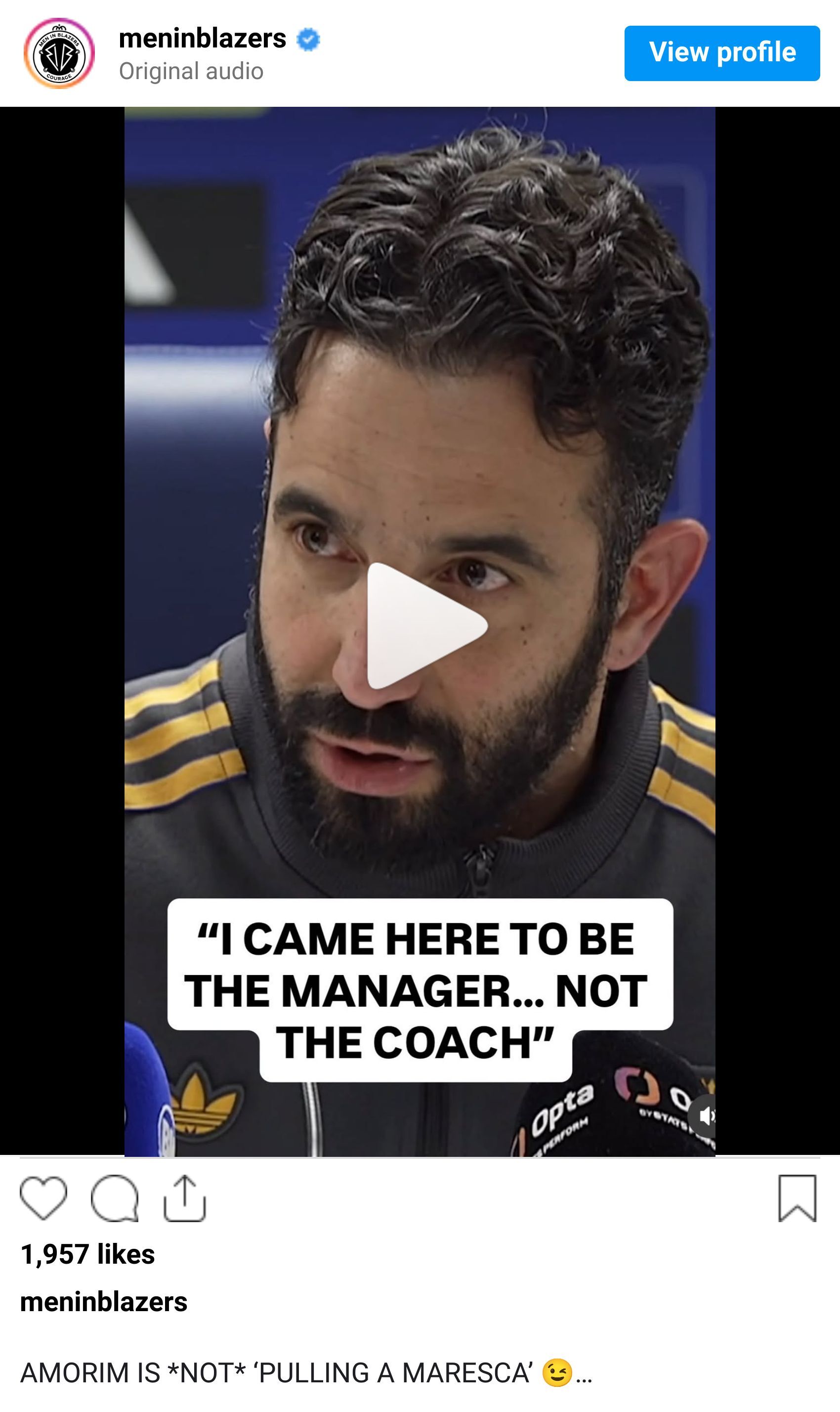
Amorim believed he had been brought in to be a manager, not a head coach. Wilcox – and presumably those above both of them in the pecking order – for reasons that are completely baffling assumed Amorim, at some point, would change the way his team played.
To use the jargon, it feels like this may well be the key learning for Amorim, whenever he feels up to reflecting on his time at Old Trafford: that what matters, when it comes to choosing his next club, will be making sure that there is no scope for a breakdown in communication on that scale, that both sides know exactly what they are getting.
It will not, though, be the only one. Exposure to Manchester United, this Manchester United, even for such a brief period of time, will have taught Amorim that it might be wise – in the future – to trust his instincts.
We Want to Hear You 🫵

We are always looking for ways to make this newsletter better, more entertaining and more informative. As such, we’d love to hear from you about what you love, what you only like or what you think makes The Correspondent unique. Your opinions matter greatly and we’d love for you to help guide this newsletter into the future.
Front Office, Shadow Role 💙

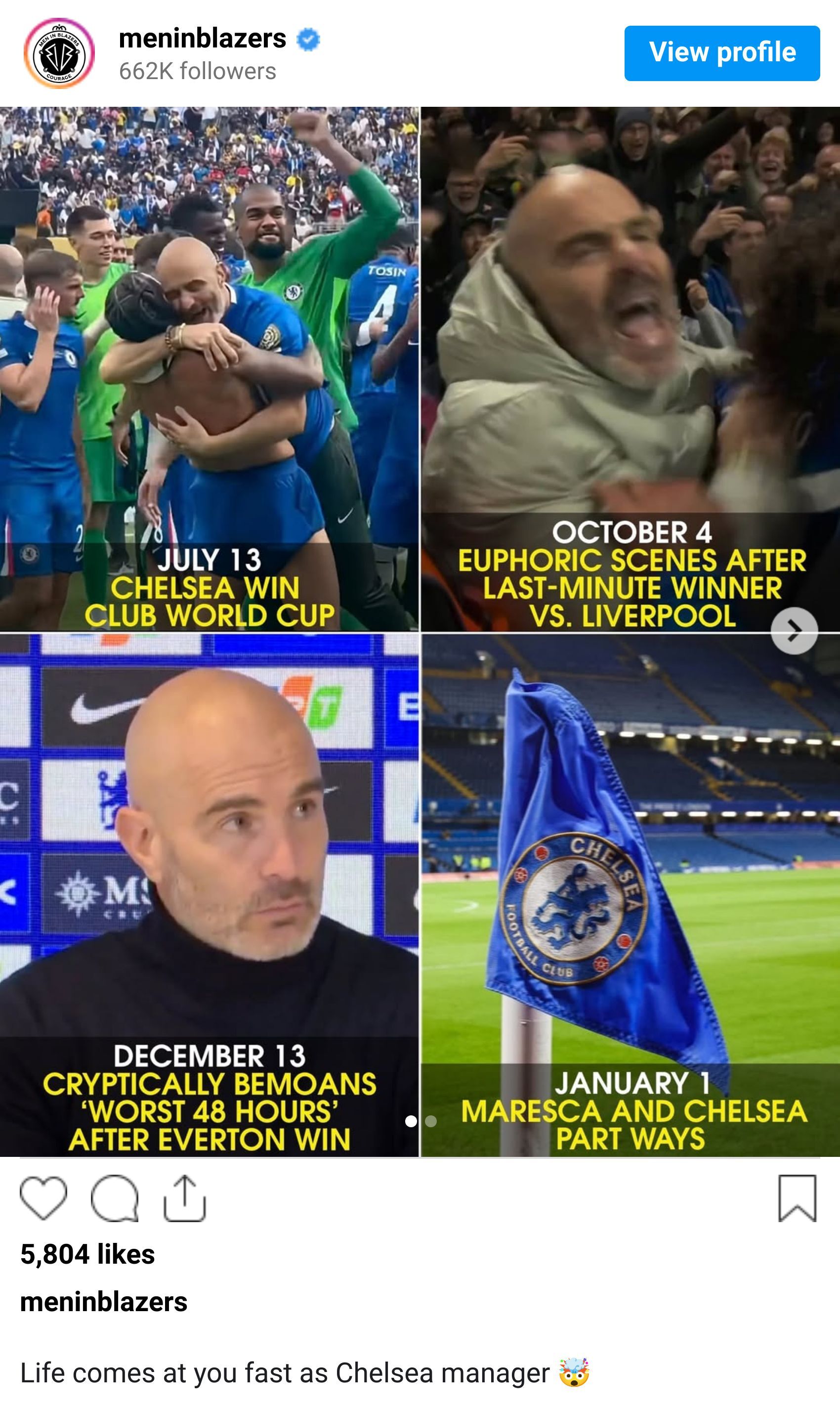
The timing was not, of course, the only parallel between Amorim’s dismissal and that of Maresca a few days previously. The Chelsea manager, too, seems to have been undermined less by performances and results – although neither was good enough to save him – than by tension with the club’s executives.
In his case, the roots of that problem appear even more tangled than at Manchester United. Maresca seems to have resented the influence of the medical department in team selection. He wanted more credit for what he had achieved with what is frequently the youngest team in the Premier League. He might have hoped that letting the club know he was in touch with Manchester City as a potential heir to Pep Guardiola would cause them to appreciate him a little more.
The issue appears to have been that he brought all of this up at precisely the wrong time, just as results were starting to turn and the club’s encouraging start to the season beginning to tail off. Maresca, in effect, tried to flex his muscles – in public – at what turned out to be a moment of weakness. He made it easy to paint him as the problem.
In both cases, though, it does feel as though the managers are engaged in a slightly uneven battle. The sorts of front offices that are in place at Chelsea and Manchester United are relatively new in England, certainly in size and scope. (The idea of the technical director itself dates back around 20 years now, on these shores, but even that can still be a source of tension.)
They are responsible, now, for several areas that were once within a manager’s remit: recruitment, the link to the academy, establishing a coherent vision for how a team might play.
They do not, though, seem to be accountable for those decisions. Unlike in Germany or Italy, technical directors do not have to answer questions in public. They do not have to explain themselves. Those enquiries are, instead, directed to the manager. And, ordinarily, if recruitment goes wrong, it is the manager who pays the price.
It is probably not a shock, then, that managers – sorry, head coaches – tend to chafe against them. Maresca and Amorim are hardly dinosaurs. They will expect to work in a model that includes input from others. But they should be forgiven for resenting the fact that while the power is diffused, the same does not seem to have happened when it comes to blame.
This Week on the MiB Pod 🎙️
Rog and Rory break down a chaotic week in the Premier League as Maresca and Amorim’s departures dominate the headlines. What do these surprise managerial changes mean for the Premier League title race, top-four battle, and relegation fight? The duo analyze which managers could be next under pressure and discuss Arsenal’s “perfect” week and what it means for their season.
Weekend Watchlist 📺
This might be a week off for the Premier League – the FA Cup takes precedence in England over the next few days, as is traditional – but the rest of Europe gets back up and running after winter breaks of varying lengths. (Except for the French, naturally.) The standout fixture is in Italy, where Inter Milan faces Napoli (Sunday, 2:45 a.m. ET, Paramount+), both of them harboring hopes of winning the title this season.
But the biggest draw, really, is a little to the south: the Africa Cup of Nations is reaching its peak in Morocco, with the quarterfinals taking place across Friday and Saturday. Seven of the remaining eight teams can be considered heavyweights, while the one remaining outsider, Mali, has shown that it will be no pushover. All four ties have plenty to recommend them, but the best may well be the last: Egypt, featuring Mohamed Salah, Schrödinger’s Liverpool forward, against Ivory Coast.
🗓️ You can find the full AFCON schedule here.
Reading Material 💻
Manchester United and the comfort of the past.
A wish for 2026: good things for Marseille.
A confession: I think Wolves are not that bad.
Jonathan Liew on Jason Wilcox, alpha chad.
Correspondents Write In ✍️
Given that we’ve taken the last couple of weeks off, it’s not really a surprise that the mailbag has been a little light over the festive period. But it’s a new year, and it’s a new you, so if you do have a question, an idea, a thought, a parallel, a query or a quibble, then please do get in touch by emailing us here. We really appreciate hearing from you!
That’s all for this week. I dread to think what will have happened by the time I write next. The Manchester City case might have been resolved. Mikel Arteta might have been sacked. Liverpool might have strung more than three passes together. We’ll see!
Have a great weekend,
Rory