
In partnership with

Greetings from Yorkshire!
I had three subjects I wanted to write about this week, all of them Arsenal-related. Seeing Mikel Arteta’s side in the flesh – as I did, for the first time in a couple of months, at Leeds last weekend – it’s hard not to be impressed. Daniel Farke evidently was; the Leeds manager was glowing in his praise of just how hard it is to play against the team that will, it seems, be champion.
But being impressed is not the same as being seduced: this was idea number one. Is part of the reason that we seem so reluctant to believe that Arsenal can see this through that they inspire awe rather than affection? Beauty is subjective, obviously, but my sense is that even most Arsenal fans would not claim their team is playing breathtaking football. (Not that they should care.)
The second thought was on a player who might, in time, be able to rectify that a little. I first saw Kai Havertz play when he was 17, stationed on the right wing for Bayer Leverkusen during a defeat at Bayern Munich. I’ve had a soft spot for him ever since, and his winding journey to appreciation and understanding is one that intrigues me.
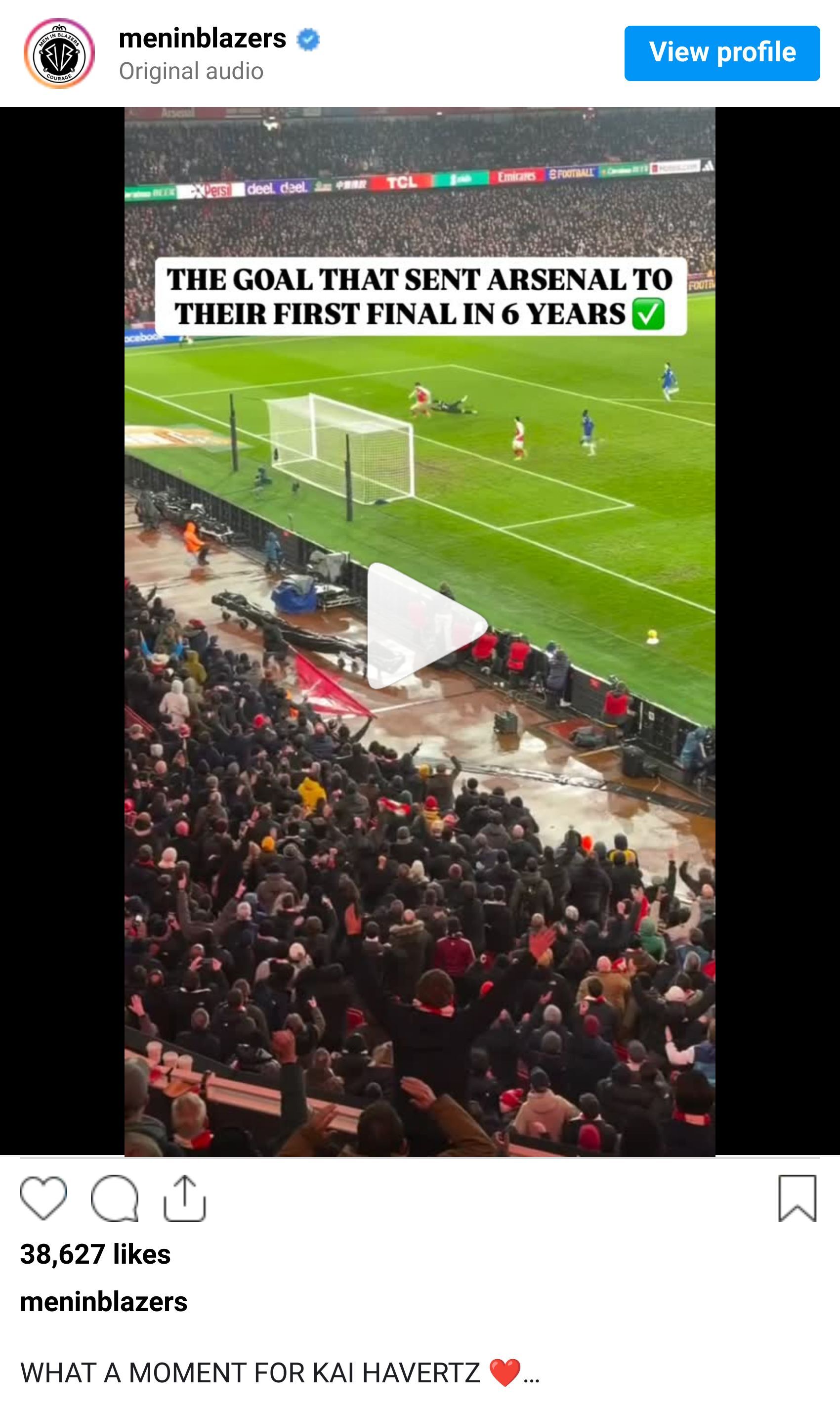
The third, though, has won out. It emerged a little bit later, after Havertz’s goal sent Arsenal to the final of the Carabao Cup at Chelsea’s expense. It meant that we can declare Feb. 3 as the day in 2026 when English football finally got to indulge the worst of all its bad habits: talking about the quadruple.


Arsenal and the Q-Word 🏆

There is nothing inherently absurd with floating the idea that Arsenal might become the first English team to win all four major trophies in a single season. It might still be a distant prospect, but it is reasonable to say it belongs in the realm of possibility. The bare facts of the matter alone make that clear.
Arsenal is top of the Premier League by six points; between them, the two sides still even vaguely capable of reeling Arteta’s team in have won exactly three of their last 12 games. A first championship in more than two decades – a first title that would be celebrated at the Emirates Stadium – is not guaranteed, but there’s no point pretending it’s not likely.
This week sealed Arteta’s team’s place in one of the two available domestic cup finals: having to overcome Manchester City at Wembley in three weeks’ time means the Carabao Cup is by no means a gimme, but Arsenal will likely go into that game as favorites. The chance to pick up a first trophy of any sort since 2020 is at hand.
The FA Cup is, realistically, too young to predict; Arsenal, like everyone else left in the competition, are basically still at the mercy of fate, in the form of whichever two former players are tasked with pulling balls from velveteen bags over the coming weeks. A home tie against Wigan means the Premier League leaders should make the fifth round; from that point on, Arsenal will be the one name everyone else would want to avoid for as long as possible.
That leaves the Champions League. By definition, this feels like the greatest obstacle, both because of the quality of opposition at every stage and because of the mounting fatigue Arsenal will have to master if they are to win it.
But there is no relevant evidence, as yet, that they could not go all the way. Arsenal won all eight of their group stage games, the first team to achieve that feat. They will play the second leg of each knockout tie at home for as long as they remain in the competition; that is no small advantage.
They will face one of Borussia Dortmund, Atalanta, Olympiacos or Bayer Leverkusen in the last 16, a list of teams that will not instill any great fear. As they should, things become trickier beyond that – Manchester City in the quarter-finals, maybe, and perhaps Paris St-Germain, again, in the semis – but Arsenal seem as well equipped to go the distance as anyone else.
To suggest that is a basic analysis is not meant to denigrate it – none of it is wrong and none of it is ridiculous – but it does not, of course, recognize the fact that all of those four tournaments are interlinked. The further Arsenal go in the FA Cup, the wearier Arteta’s players will be for the Champions League; the further they go in the Champions League, the greater the pressure will be to win the FA Cup. There is a reason nobody has won a quadruple before.
That is not, though, the most pressing problem with this particular strain of discourse. The quadruple was, until relatively recently, not a thing that anyone talked about. Nobody expected Liverpool in the 1980s or Manchester United in the 1990s to complete a clean sweep of (meaningful) trophies. Doing the league and cup double, for decades, was seen as the ultimate barometer of greatness.
That has changed in recent years as elite teams have started to monopolize both players and success. The double in England was completed so frequently that it was effectively devalued in the early 2000s; the great aristocratic houses of Europe now complete trebles with sufficient regularity that it is almost their baseline achievement.
This is something the game’s authorities should be far more concerned about than they appear to be. It has led to a sort of rampant inflation: trophies, at a host of clubs, are now worth far less individually; only collecting a great suite of them is something to be celebrated.
In 2019, for example, executives at Manchester City were adamant that they had to include the Community Shield in their trophy haul; otherwise, they worried, their treble of Premier League and two domestic cups might look less impressive than the version Manchester United had pulled off 20 years previously. Despite being warned most fans did not take the Community Shield seriously, that side was duly christened the “Fourmidables.”
That inflationary spiral has a downside: both for the game as a whole and, more pertinently, for the team involved. It seems obvious that it should be a source of great pride for Arsenal that, as late as February, there remains even a possibility that they might complete a clean sweep of trophies; that is, sadly, unlikely to be remembered should they fail to deliver a majority of them come May.
It is perhaps a little too cynical to suggest that the quadruple is only floated when the identity of the league champions is no longer in any real doubt; it is more reasonable to suggest that, once it does emerge, there is an impulse to deploy it as a weapon.
From this point on – through no fault of their own – Arsenal ending the season as league champion and, for example, Carabao Cup winners may well be presented as a sort of failure, an opportunity missed, proof that they have somehow fallen short. It feels, in fact, as though the word itself is a sort of trap: a way of guaranteeing that any success at all can be dressed up to look like failure.
This Week on the MiB Pod 🎙️
Rog and Rory break down a wild weekend of Premier League action, reacting to Arsenal’s statement win away at Leeds, Manchester United’s winning run under Michael Carrick, and why Liverpool are unlikely to finish in the Premier League top five despite their win against Newcastle.
Liverpool’s Big Gamble 😰

The final 48 hours of the January transfer window – you may not have noticed it; very little happened – were strange ones for Liverpool. The soon-to-be-deposed Premier League champion was typically decisive in overtaking Chelsea to agree a deal to sign Jeremy Jacquet, a much-coveted defensive prospect, from the French club Rennes in the summer.
Liverpool’s move for Lutsharel Geertruida, on the other hand, seemed slightly chaotic. On Sunday, it all seemed to be moving ahead. Geertruida, capable of playing across the defense, was on loan at Sunderland from RB Leipzig; Liverpool would, in effect, take over that deal and reunite the Dutch international with his former manager at Feyenoord, Arne Slot, for a few months.
Seeing it written down, maybe it is not a surprise it proved too complicated to piece together at such short notice: by Monday morning, the deal was off, although who made that decision is still somewhat unclear. What strikes me as being much more noteworthy is the fact that Liverpool did not pursue an alternative.
To put it bluntly: Liverpool needs a sharp uptick in form to qualify for the Champions League. It also needs a decent run in the Champions League if it is to salvage anything from this season; my personal view would be that it should be thinking about the FA Cup in exactly the same way. There is a lot of football to play, and all of it matters.
And Liverpool has elected to confront that with four fit defenders. Five, if you count Joe Gomez, which (very sincerely: sadly) you probably should not. Slot currently has no specialist right-backs, and he may not for at least another month. Liverpool’s whole season basically rests on none of its defenders picking up an injury.
This is, as they say, a choice. And it is one with consequences. First and foremost: missing out on the Champions League would be a blow to Liverpool’s finances and its ambitions; retooling the squad in the summer will be much harder without the carrot of Europe’s premier competition.
Just as importantly, it makes it very difficult to assess how Slot has performed this season. He has struggled, without question, to find a way to arrest Liverpool’s slump; he has found it hard to work out how to get the best out of the talented but mismatched squad he has been handed.
But he could also, now, legitimately suggest that the club’s executives have not really given him a fighting chance to make up for those mistakes, to rescue something from this season. If Liverpool do end up outside the top five in May, there will be an awful lot of fingers pointing at Slot. His, though, might well be aimed at the people above him.
Reading Material 💻
Anatoliy Trubin and the best moment of the season.
More praise for Arsenal.
I’m fascinated by the issue of neck-guards at the Winter Olympics.
Britain’s two main cultural forces collide.
This newsletter now also does baking recommendations.
The Watchlist 📺
Not all that long ago, Liverpool against Manchester City felt like the Premier League’s derby of the future. Games between Jürgen Klopp’s Liverpool and Pep Guardiola’s City were the showpieces of each domestic season; in at least a couple of campaigns, their outcome directly influenced which of the two finished as champion.
Sunday’s installment (11:30 a.m. ET, Peacock) is still a big game – Liverpool has to win to remain in the race for the Champions League; City must to retain any hope of catching Arsenal – but it feels unavoidably diluted. That is, I think, a marker of a newer rivalry: they are dependent on the stakes; if they diminish, the fervor tends to follow.
The same cannot be said of Paris St-Germain against Marseille. Once again, it looks like PSG has now eased into a position of dominance in Ligue 1 that it will not abandon. But that does not mean the Parc des Princes will be any less of a cauldron for Le Classique. The game may not be a thriller, but it will be worth watching for the atmosphere (Sunday, 2:45 p.m. ET, Fubo).
Correspondents Write In ✍️
This may well be a first for this newsletter – we have a contribution from a reader, Lukas Stevens, all the way from Germany. But don’t worry: he’s thinking about Tottenham and Manchester United. “My theory is that their malaise could partially stem from the lack of consequences they face for their ongoing mismanagement,” he wrote.
In the Bundesliga, “many storied clubs have been humbled by relegation after years of mismanagement.” That has forced those teams, as well as the likes of “Stuttgart, Eintracht Frankfurt and to a lesser extent Borussia Mönchengladbach to rethink their place in the pecking order and find radical new approaches.”
Lukas believes that Spurs, United and the rest have so much money that they are “essentially immune from ever being relegated, and can even still compete for international titles.” That leaves them free to throw as much cash as they can at trying to regain their “rightful place,” without any real incentive “to pursue a new approach with conviction and stamina.”
This is a good theory, and there’s no question in my mind that the amount of money Premier League teams earn for being in the Premier League has the effect of saving a lot of them – especially the big ones – from quite a lot of hard thinking. United, in particular, has been held back by the blend of complacency and institutional conservatism that Lukas describes.
But I would point out that there is more than one type of relegation: United has, over the last few seasons, effectively been relegated from the Champions League. Spurs are running the risk of being relegated from the top six. There is a lot of domestic competition to keep everyone honest, although it is absolutely right to say that all of these teams have a very high floor; Spurs found out precisely where it sits just last season. They are all, now, too big to fail, and that is an issue.
And we’ll finish on an even more complex question from Andrew Alvarez. “I was delighted by the reference to Terry Pratchett in last week’s Correspondent,” he wrote. “I was wondering which of his books are your favorites, and if you have introduced Sir Pterry to your kids.”
Not yet, in answer to the second one, although Santa did bring him a copy of “Guards! Guards!” The idea is that we’ll read it together this year, as a sort of respite/reward for slogging through “Harry Potter and the End of the Series,” or whatever the last one is called. It’s quite a high-pressure parenting moment: I’m really excited to read the Pratchett books with him, but I am also conscious I will be DEVASTATED if he doesn’t like them. As for my favorites: I’m not sure I could choose between any of the City Watch series, but I have an (unsurprising) soft spot for “The Truth,” “Thief of Time” and “Going Postal,” too.
I’d better stop there or I’ll be listing Terry Pratchett novels all day. Or at the very least introducing mordantly funny footnotes into my work. Thanks so much for reading, and remember that if you have any questions, ideas, quibbles or literary recommendations, please send them on to [email protected]. We love hearing from you!
Have a great weekend,
Rory
If you’re enjoying The Correspondent, we’d love an assist. Forward this email or share this URL with a friend, family member, or fellow football fan.
First time with us? Sign up here to get Rory’s next edition sent straight to your inbox, and check out our other newsletters too.
Can this idea actually make money?

The fastest way to find out is simple — launch a newsletter and website in minutes, then turn what you know into something people can buy.
With beehiiv’s Digital Product Suite, your expertise becomes real products: a short guide, a playbook, a set of templates, or limited access to your time. No friction, and no code required. Just create, price it, and share it with your audience.
And unlike other platforms that quietly take 5–10% of every sale, beehiiv takes 0%. What you earn is yours to keep.
For a limited time, get 30% off your first 3 months on beehiiv with code PRODUCT30.