
Greetings from Yorkshire!
A little bit of a change to this week’s newsletter. It has been, as you will have noticed, a fairly frantic week, even by the Premier League’s standards: 20 games in the space of six days, with brief interludes for two teams to fire their coaches. Instead of trying to pick my way through them, I’ve taken the opportunity to delve into the email inbox, and answer one of your questions.
It’s a good one, I think. “I’d love to hear your take on exactly why the Premier League has grown to dominate culturally and financially over other domestic leagues,” wrote Paul Rudnicki. “It’s not immediately obvious why this should be so. Do the English love football more than the French or the Italians? Does England have more wealth than Switzerland or Germany? Did the British export their club allegiances more efficiently to their former colonies than their imperial competitors?”
There is a widely accepted answer to this question, one that English football, certainly, likes to tell itself. But I’ve always thought it is somewhat incomplete, so Paul’s invitation to offer my theory is a welcome one. Why has the Premier League grown to become such a behemoth? Is it just the natural order of things? Is it the triumph of untrammeled capitalism? The answer: sort of, but not really.


How the Premier League Conquered the World 🌍

Nobody, up to and including the people involved, could possibly have foreseen how successful the Premier League would be. In 1990, when representatives of England’s five biggest teams first started discussing a breakaway competition – what would in effect be a second founding of English football – they had no way of knowing what they were creating.
English football, after all, seemed to be in a state of decay so permanent that many felt it was irreversible. The 1980s had been shrouded in tragedy: 39 killed at Heysel, 56 at Bradford, 96 at Hillsborough. (The death toll there would later be increased to 97.) Fears over both safety and hooliganism had seen attendances crater. The country’s stadiums were not just crumbling, but deathtraps. English teams had been banned from Europe.
The established version of how English football went from there to here – a world in which the Premier League is so strong, so rich and so appealing that it is now an active hazard to the ongoing health of every other domestic competition on the planet – tends to treat it as largely an exercise in corporate ingenuity.
It is, in this telling, a parable of how great men, and great ideas, can define their own destiny, with just a sprinkling of English exceptionalism thrown in. In short: the founding members of the Premier League recognized that there was money to be made in football if only they could free themselves of the shackles of the game’s antiquated structures.
When the Premier League started in 1992, it unmoored the country’s biggest clubs from the Football League. The new organization was more forward-thinking, more nimble and, crucially, much richer. It no longer had to share its income with the rest of England’s beloved pyramid; it was free to grow fat on booming broadcast deals.
Most importantly: that income was shared equally, ensuring that all of the league’s clubs saw at least some of the benefits. The rising tide lifted all boats; that, in the Premier League’s version of events, was the secret. Unlike Serie A or La Liga – its two great rivals – England offered genuine competitive balance. The belief that only in the Premier League could anyone beat anyone became a sort of creed. Every game was uncertain, thrilling, proof of the clubs’ great wisdom. That, more than anything, lay at the root of the Premier League’s growth, the fountainhead of the global fans, the glamorous players, the unfathomably wealthy owners that followed.
That account is not untrue, but it does omit a handful of factors. A couple of these tend to be included in broader examinations of the Premier League as a phenomenon. Most, for example, would point to the role of Hillsborough in making the rehabilitation of English football possible; the deaths of the 97 would lead to the Taylor Report, which forced clubs to make their stadiums fit for purpose.
And many would acknowledge the league’s fortuitous timing. At roughly the same time as England’s leading clubs were chafing at the restrictions of the old model of the game, Rupert Murdoch was attempting to launch a new type of television in the country. His satellite broadcasting network needed a blue-chip product to entice subscribers. Football could not have been a more perfect vehicle. Murdoch agreed to pay over the odds to secure the rights to the Premier League. The boom had begun.
This element of the story is, I think, traditionally underplayed. I wrote a couple of weeks ago about football’s desire to believe in the Great Man Theory of History, the idea that what shapes the world we live in more than anything else are big people with big brains doing big things. As a result, it tends to ignore – or at least diminish – the impact of more structural forces.
It strikes me, for example, that the role of (what would become) Sky in creating the modern Premier League is not a minor addendum; it is a central factor. The Premier League’s rapid development in the 1990s was because English football was the first to understand itself less as a sport and more as a television product.
Only in the Premier League, for example, were the boom microphones on the edge of the field situated to pick up crowd noise, rather than the grunts and the exhalations of the players; it was vital, the league’s producers understood, to make games feel like a spectacle. Likewise the foresight to make stadiums look as full as possible, even when they were not. In Italy, even now, lower tiers of stadiums tend to be sparsely populated. In England, every ground looks packed. It is a visual cue: this is something you really have to see.
The Premier League sold that vision, relentlessly, around the world; after a while, the marketing spiel was accepted as fact. It was enabled in that by two things that are overlooked almost entirely whenever the league’s origin story is told.

The first is technology. The Premier League was only able to build its global appeal not only because a widespread infrastructure of satellite and cable television existed but because that meant there were a suite of networks out there desperate for content.
English football might have fractured at the start of the 1980s, rather than the end. Had it done so, it would likely not have been the marvel it turned out to be. More by accident than design, the Premier League got its timing right. In doing so, it granted itself a first-mover advantage. Italy, Spain and the rest could only ever play catch-up.
The second edge was language. The Premier League might be a polyglot place, now, after three decades of constant recruitment from all four corners of the planet, but it is also very much in English. Even leaving aside their broader cultural cachet, Manchester United and Liverpool and Newcastle are more approachable – even to non-English speakers – for being rendered in the global lingua franca.
It is the same dynamic that serves to make Real Madrid, Barcelona and to some extent La Liga as a whole so popular in South and Central America: the language of a competition has an effect on its popularity. The Premier League succeeded not just because it was selling a product that was shiny, exciting, made for television, but because it was doing so in English. That helped most of all in the United States, in Australia, and in parts of Africa, obviously, but it was an advantage across the planet more broadly, too.
To some extent, all of that feels like ancient history. The Premier League’s primacy, now, is a self-repeating cycle: it attracts the most viewers, so it gets the biggest television deals, so it gets the richest owners, so it pays the biggest salaries, so it recruits the best players, so it attracts the most viewers, and on, and on, and on.
That was all kickstarted, though, in the 1990s, when the league was able to lay the groundwork for what would become its unassailable advantage, its unstoppable momentum: partly because of the inspiration of its executives, yes, but also because of a bit of good timing, emergent technology, and (as Paul suggested) the legacy of centuries of colonialism.
📬 Enjoying The Correspondent? Check Out Our Other MiB Newsletters:
🐦⬛ The Raven: Our thrice-weekly newsletter where we preview the biggest matches around the world (and tell you where/how to watch them) and recap our favorite football moments from throughout the week.
☀️ The Women’s Game: Everything you need to know about women’s soccer, sent straight to your inbox each week.
🇺🇸 USMNT Only: Your regular update on the most important topics in the U.S. men’s game, all leading up to this summer’s World Cup.
Permanent Dissatisfaction 😒

This has been the season of the boo. I’ve not done the precise math on it, but somewhere around half of the teams in the Premier League must have been booed by their own fans at some point. Brighton was booed last weekend. Liverpool has been sort of semi-booed on several occasions. Manchester United, too, before salvation appeared in the form of Michael Carrick.
The fact we have now seen three of the most high-profile managers in the league lose their jobs feels like it is probably related. (Nottingham Forest, now searching for a fourth manager of the season, can probably be safely dismissed as a rule unto themselves.)
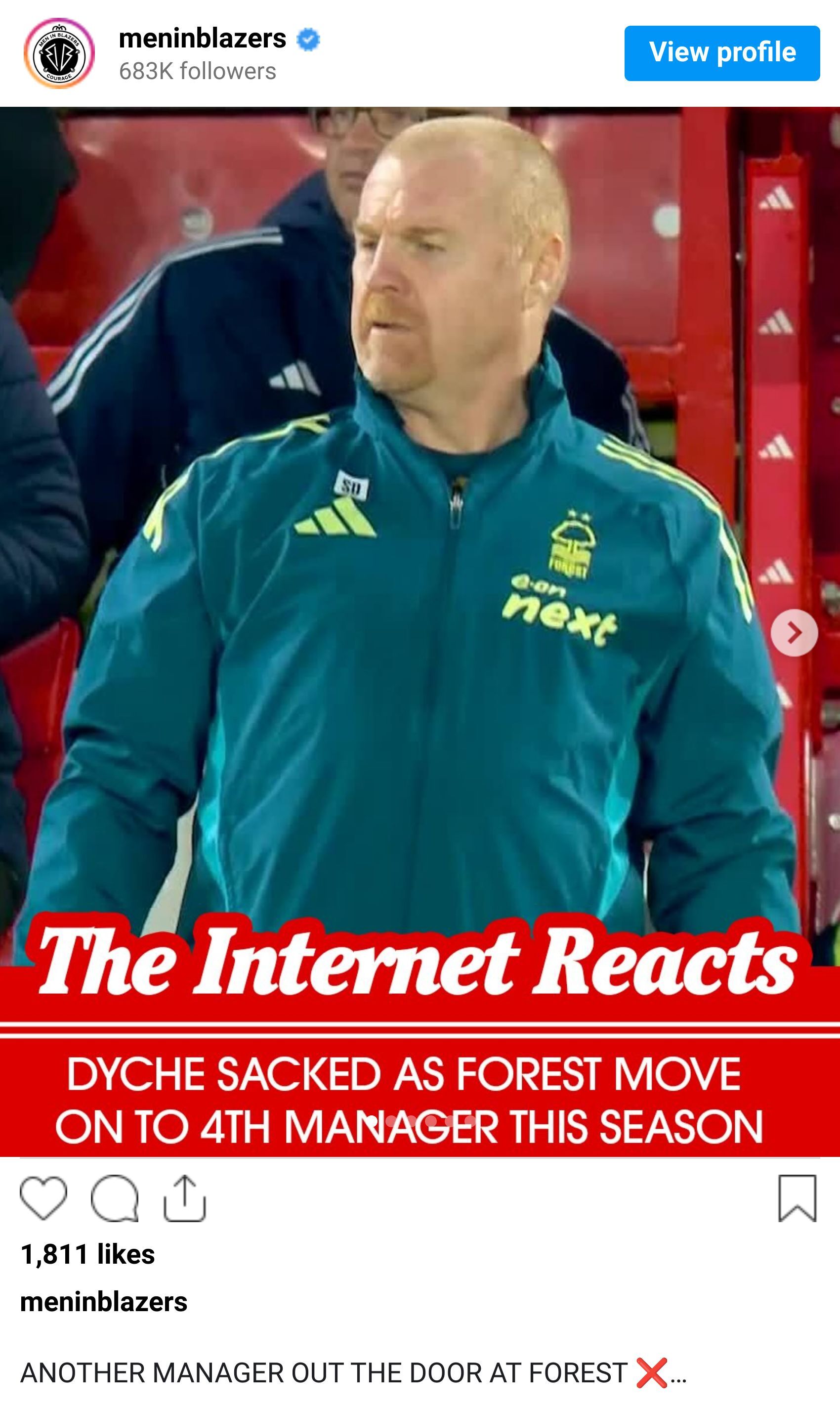
There was no huge surprise when Thomas Frank joined Ruben Amorim and Enzo Maresca in being relieved of his duties on Wednesday; Tottenham had been booed so often that, by the time the final whistle went against Newcastle, the fans could not even muster the energy to be truly angry. They were just disappointed.
Frank has always been an engaging, intelligent presence in the Premier League, but Spurs’ results have been so poor that it is hard to quibble with the decision, or with the fans’ dissatisfaction that precipitated it. Frank’s appointment did not work, and there was no sign that he was going to be able to rectify that. I suppose the question is: are fans now so predisposed to turning that managers are going to find difficult periods increasingly fatal?
This Week on the MiB Pod 🎙️
Rog and Rory break down Manchester City’s controversial 2–1 win over Liverpool at Anfield, diving into the VAR decisions, the cards shown, and what really should have happened. Plus, they review Arsenal’s 3–0 win over Sunderland and why the word “quadruple” is suddenly back in the conversation. The duo also discuss Manchester United’s run of form and check in on the tense relegation battle at the bottom of the table.
Reading Material 💻
Are we watching Pep Guardiola’s last stand?
The sad end of the Crystal Palace fairytale.
Sitting down in a Pizza Hut is true luxury.
Saudi Arabia’s empty promises in Newcastle.
For further reading on the rise of the Premier League (a hearty recommendation).
The Watchlist 📺
Let’s use the excuse of the FA Cup – which has not, if we’re all honest, produced what you could call a classic draw – to cast our eyes a little further afield. This weekend brings not one but two outstanding derbies in Serie A: Saturday’s Derby d’Italia, between Inter Milan and Juventus (2:45 p.m. ET, Paramount+), followed by the Derby del Sud (I think), in which Roma visits Napoli (Sunday, 2:45 p.m. ET, Paramount+).
Those games are appealing enough without the context, which is that they involve four of the top five in the league. (AC Milan, made famous by Christian Pulisic, is the only one of the leading pack not involved.) Serie A generally produces the best title races of all of Europe’s major leagues; with Inter eight points clear, this is possibly the last chance of the division continuing that tradition.
But the biggest game of the weekend – anywhere, no hyperbole – is in Glasgow, where a resurgent Rangers face Hearts, which remains the best story in Europe (Sunday, 11:30 a.m. ET, Paramount+). A reminder: nobody apart from Glasgow’s big two has won the Scottish title in 40 years. Hearts have been stuttering, but they’re still just about there. Getting out of Ibrox unscathed would be a major hurdle cleared.
Bonus Thought ✍️
Seeing as a correspondent provided the inspiration for the bulk of the newsletter, I thought it would be unseemly to outsource the final section this week. Instead, here is a dubious prize for you all: a brief diversion to talk about VAR.
For reasons that anyone who has read this far down will understand, I’m not inclined to linger on the events at Anfield last Sunday. The absurd denouement, though, functioned perfectly as a microcosm of just what football has done to itself in the quest for (unattainable) accuracy from referees.
To recap: Dominik Szoboszlai was sent off for denying a goalscoring opportunity to Erling Haaland, despite the fact that Rayan Cherki had actually scored. It feels a little like a philosophical brain-teaser. If a tree falls in the woods and nobody is around, does anyone hear it? If a goal is scored, how can someone be sent off for denying a goalscoring opportunity?
The decision, it seems, was correct according to the much-trumpeted Laws of the Game. It was not, though, correct in any other sense. It was, on the face of it, wholly ridiculous. But it was also a distillation of the bind in which we have placed the game: we have asked officials both to be consistent and to apply common sense. What happened at Anfield was proof, conclusive proof, that you have to choose. And, for that matter, that we have chosen wrong.
That’s all for this week. Please keep your ideas and thoughts and questions coming in, we love hearing from you.
Have a great weekend!
Rory
🙌 If you’re enjoying The Correspondent, we’d love an assist. Forward this email or share this URL with a friend, family member, or fellow football fan.
📧 First time with us? Sign up here to get Rory’s next newsletter sent straight to your inbox, and be sure to check out our other MiB newsletters too.
👋 As always, you can send any feedback, thoughts, or odes to Terry’s Chocolate Oranges to [email protected].
Tired of news that feels like noise?
Every day, 4.5 million readers turn to 1440 for their factual news fix. We sift through 100+ sources to bring you a complete summary of politics, global events, business, and culture — all in a brief 5-minute email. No spin. No slant. Just clarity.