
Greetings from Yorkshire!
My friend Neil Atkinson, of The Anfield Wrap, texted me a little pop quiz on Sunday evening. Across the Premier League weekend, only one team had succeeded in beating a side that had – at the start of play – been below them in the table. No phones, no conferring, off the top of your head: if you said Sunderland, congratulations. You can have a sticker.
The subtext to the question is one that’s come up both on the “Men In Blazers” podcast and in The Correspondent, and it feels to me like it’s the story of the season: the Premier League does not work like it used, or is supposed, to work.
Another factoid: In the last three rounds of Premier League fixtures, the current top six have played 18 games. They have won four of them. Combined. One each for Arsenal, Aston Villa, Manchester United and Chelsea. Liverpool is unbeaten in 12 but has not won in four. Nor has Manchester City. (Chelsea has as many points from its last six games as Wolves.)
There’s been plenty of exploration of where that competitive balance has come from: it is because teams are good, or bad? Is it tactical, or is it to do with broader forces? But it is just as worthwhile trying to think about what it does, because I think it is probably related in some small way to the unhappiness that seems to pervade so many teams across the league. Almost everyone feels as though they’re doing badly. But some teams feel they’re doing much worse than others.


Tottenham Hotspur’s Identity Crisis 🤔

When the boos came, as Thomas Frank must have known they would, it was with the volume and the ferocity of a dam bursting. Tottenham’s fans had been sitting in their eponymous stadium, simmering and stewing, a great bilious pool of discontent curdling inside them, waiting for a chance to vent. The final whistle provided it.
Booing has been the soundtrack to much of this Premier League season. There have, at various times, been boos at Old Trafford and at Stamford Bridge, at Nottingham Forest and at Wolves. There were boos at Anfield last weekend, a place still full of memories of winning the title. There are boos at West Ham basically all of the time.
It feels, increasingly, as though fans are walking into stadiums preconditioned to boo, with a boo in their back pocket, a boo they should maybe have to declare at the security scanners. Often, the roots of their dissatisfaction are shared: fury at a club’s lack of direction, or vision; a tension between how much their team cost and how entertaining or successful they are; a sense that this is an extremely expensive and quite stressful hobby that is not proving a worthwhile investment, financially or emotionally.
The boos at Spurs, though, were different. They felt definitive, final, irretrievable, more like the issuing of a judgment than the expression of an opinion. They were not the sort of boos that might be turned around or forgotten. It was hard, as they rang around the stadium, to see how Frank might recover.
Football has a rich enough history that it is not entirely possible to rule anything out, of course: Alex Ferguson was jeered three and a half years into what turned out to be a 27-year reign at Old Trafford. But citing Ferguson is the last refuge of the damned, taking English football’s greatest ever exception and trying to make it a rule.
The likelihood, then, is that Frank’s time at Tottenham will be a short and unhappy one. Beating Borussia Dortmund, convincingly, on Tuesday doused the flames just a little; a win at Burnley this weekend would at least restore a bit of dignity. But we are at the stage now where all it will take is another setback – a defeat to Manchester City, or Manchester United after that – and the boos will come again. Frank may hang on for a while, but he will never recover, not really.
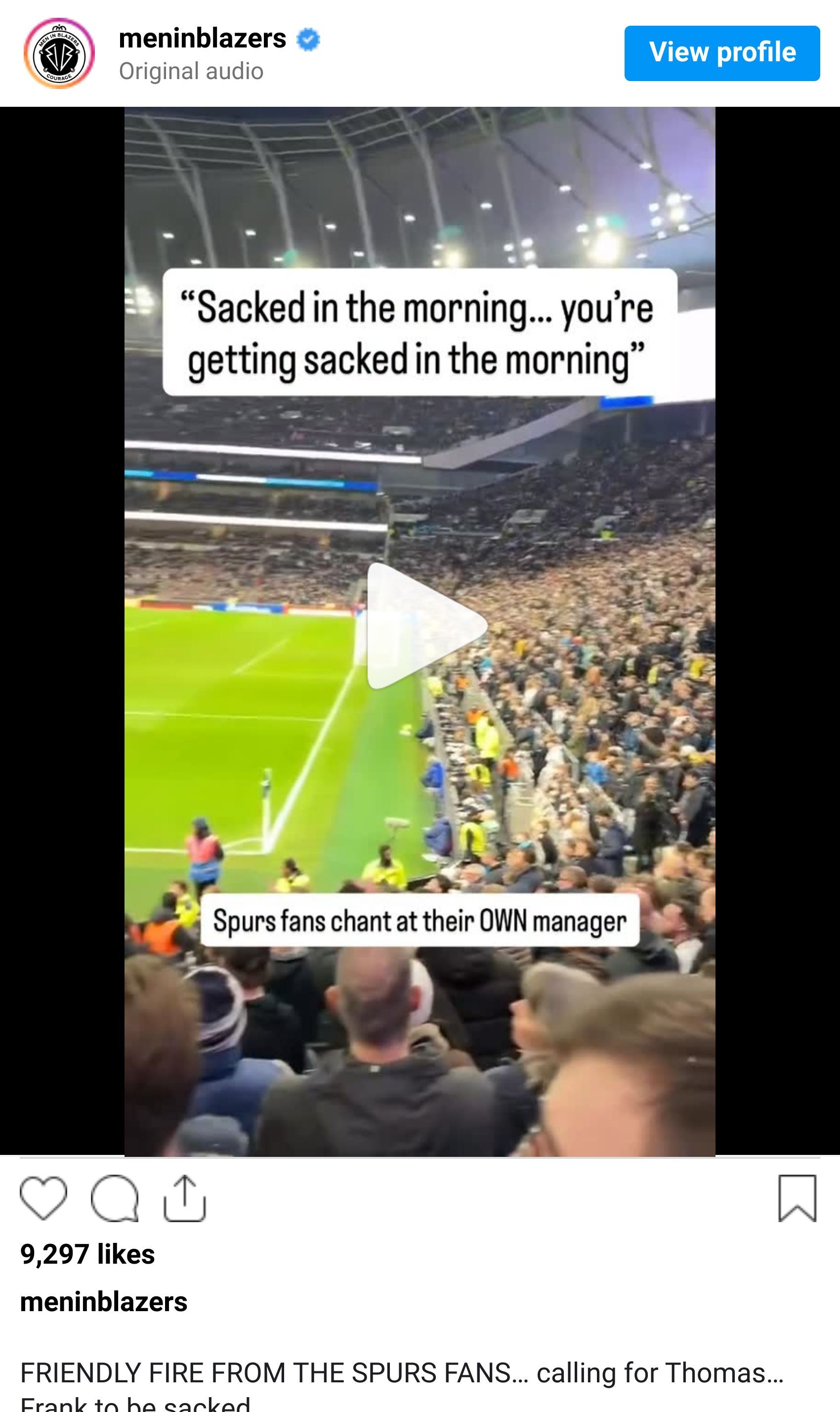
As emotionally intelligent, charming and charismatic as he is – and talented; we should not allow what has happened at Spurs to blur the excellent work he did at Brentford – Frank has to take some measure of responsibility for that.
He has struggled not just for results but to turn Tottenham into an attractive side, to give his team’s fans reason to believe. He has failed to meet the part of his job description that is best encapsulated as “salesman,” to realize that managing an elite team – or at least one that regards itself as elite – involves a degree of tub-thumping and chest-beating.
But what has undone him, more than anything, is precisely what undid all of his predecessors since Mauricio Pochettino, and what will lie in wait for whoever is anointed as his replacement: Tottenham, perhaps more than any other club, is trapped between what it would like to be, what it thinks it should be, and what it is, between ambition and reality.
That is not meant as a criticism. In a way, it is testament to the growth the club has had in the last 20 years, transformed by judicious management – both sporting and corporate – from an upper mid-table also-ran into a genuine (if probably junior) member of the game’s elite. Spurs have the best stadium and training facility in England. They are a regular feature of the Champions League, and are the reigning Europa League champions. They were invited to be part of the Super League. That would not, it is fair to say, have happened a couple of decades ago, when Martin Jol was in charge and Paul Stalteri was in the team.
But the problem that Spurs have, now, is that the upward trajectory has slowed almost to a halt. It is a club that looks and behaves and feels, above all, like a giant; it has a fanbase that has grown used to going places, that is desperate for that next step, that has felt on the edge of glory for years, that senses that realizing its ambitions is so, so close.
Except that it isn’t. Spurs are, economically, the fifth or sixth richest club in England. That is quite an achievement. It is also an intense frustration, because it means that Spurs feels like they should be competing for honors more frequently than they are, but at the same time must do so against four or five teams with still deeper pockets.
Put it another way: to qualify for the Champions League, Spurs have to overachieve and hope one of their opponents underachieves. To win the title, Spurs have to rely on four or more of them failing to live up to expectations. That is, of course, unlikely in the extreme. And that means that Spurs find themselves, most of the time, in a sort of unhappy purgatory, one in which consistency feels like stagnation, and competing feels like failure.
Frank, of course, has not even been able to take Spurs to where they should be, let alone where they wish to be. His results, ultimately, have not been good enough. But that is not what will damn him. As much as anything else, those boos were an expression of a disconnect between the fans and the club as a whole: manager, players, project. What Spurs fans need is a manager, or a player, who can make them believe in something. It is there, in his eight months, that Frank has fallen short.
📬 Enjoying The Correspondent? Check Out Our Other MiB Newsletters:
🐦⬛ The Raven: Our Monday and Friday newsletter where we preview the biggest matches around the world (and tell you where/how to watch them) and recap our favorite football moments from the weekend.
☀️ The Women’s Game: Everything you need to know about women’s soccer, sent straight to your inbox each week.
🇺🇸 USMNT Only: Your regular update on the most important topics in the U.S. men’s game, all leading up to this year’s World Cup.
Palace’s Glass Ceiling 🦅

Most Crystal Palace fans, from what I can gather, did not expect the glory days to last forever. They knew it would come to an end, sooner or later, that the Premier League’s unforgiving economics would reassert themselves eventually. What they might not have anticipated was the speed at which everything seems to have unraveled.
Or, for that matter, the apparent acrimony that seems to have been festering at the heart of English football’s great feel-good story. Looking back, it feels almost like that FA Cup defeat to Macclesfield had the same sort of determinative power as the Chicago Bears/Super Bowl (with thanks to Garbage Day) conspiracy theory: it has snapped Palace back onto a different timeline.
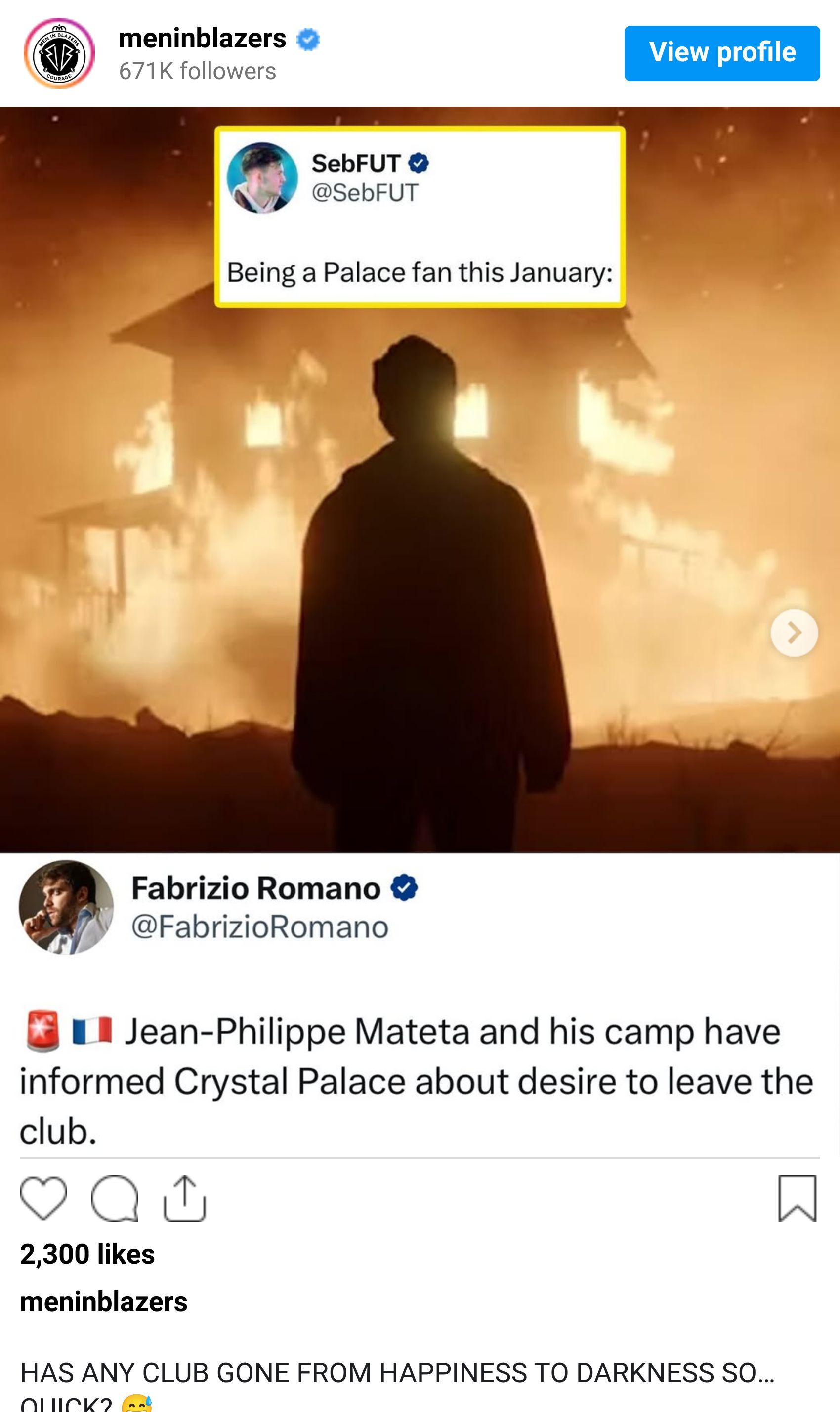
Within the space of a week, the club has sold its captain, Marc Guéhi, for a little more than half the money it would have received had it sold him in the summer; Oliver Glasner, the manager, has revealed that he is not sticking around; he has aired his grievances against the club’s hierarchy, twice, in the starkest terms imaginable. To cap it all off, now Jean-Philippe Mateta appears to have told the club that he would to go, too, and he would quite like it to be soon.
This was all, probably, inevitable. Football’s economics are brutal. Feel-good stories are habitually picked apart by the giants they seek to topple. Fairytale stories do not last. There are two ways of reacting to that. One is to focus on how sad it is that all that Palace built has fallen apart so quickly. The other is to use it as a reminder that happiness, in football, is fleeting. It is worth enjoying it as much as you can, whenever it happens.
This Week on the MiB Pod 🎙️
Arsenal drop points but remain top of the Premier League — how big is the result in the title race? Rog and Rory break down the latest Arsenal performance and what it means for their title pursuit. They also discuss Manchester United's impressive win in the derby, another lackluster Liverpool performance in their unbeaten run, and dive into the bigger question: are we entering a post-manager era in football?
Reading Material 💻
Saudi money, FIFA politics, Fijian escapes: the league that could change football.
I went to Old Trafford and decided Manchester United might as well believe in magic.
An Elvis festival in Australia’s Outback.
The brilliant Maher Mezahi on the Cup of Nations final.
A wonderful piece of Evertoniana.
The Watchlist 📺
Arsenal against Manchester United has, for quite a while, been one of those games that sounds grander than it is. Twenty years ago, this was the biggest fixture of the English season; now, its prominence can largely be attributed to the two teams’ popularity – and the age of the people who get to decide which games are treated as Main Events – more than any genuine tension.
This edition, though, caps a subtly intriguing Premier League Sunday. (Saturday is…not great.) The reaction Oliver Glasner receives when Crystal Palace hosts Chelsea will be fascinating (9 a.m. ET, USA). Aston Villa probably has to beat Newcastle to maintain even a semblance of a title challenge (9 a.m. ET, Peacock). And, after their destruction of Manchester City last week, maybe Michael Carrick and his revitalized players can capitalize on Arsenal’s recent stumbling (11:30 a.m. ET, Peacock).
Outside England, meanwhile, there are two games very much worth your time: the Hamburg derby on Friday afternoon (2:30 p.m. ET, ESPN+), in which HSV visits St. Pauli’s Millerntor-Stadion with both teams fretting about relegation, and Marseille hosting Lens in Ligue 1 on Saturday (3:05 p.m. ET, Fubo), a game between two sides with actual aspirations of beating PSG to the title.
Correspondents Write In ✍️
We should remember, when considering Lloyd Mallison’s email, that he sent it before Manchester United ripped Manchester City to shreds at Old Trafford on Saturday. He is not being wise after the event; he was being wise – maybe – before it.
“Is there not a legitimate, logical case for Da Boys as United’s best option right now?” he asked. “While undoubtedly undergirded by nostalgia and ‘what if?’,” he wrote, a romantic candidate in the mould of Ole-Gunnar Solskjaer or Michael Carrick might be a “house-recipe Rijkaard type, a presence that authentically reconnects with tradition that has leaked out of the club in the last decade.”
Lloyd was writing with Solskjaer in mind, but Carrick’s first performance sort of proved the point. Yes, his presence is evidence of United’s lack of strategy and vision and patience; but no, that does not mean it is a bad idea in the circumstances, or even that it could not work. I was at Old Trafford for his debut, and the place did feel re-energized: not just by the sight of an old hero, but by the sort of football he seemed to want his team to play. There are less worthy aims than just to make fans want to watch their team again.
That is not, sadly, the case at Anfield. Michael Simmons was in touch to bemoan “Liverpool’s ability to turn a 4-0 win into a 1-1 draw. What more is there to say?”
It still feels both absurd and ungrateful to me that Arne Slot is under such intense pressure nine months after winning the actual Premier League, but the reaction to Saturday’s draw with Burnley was telling nonetheless. It was, in the technical term, one of those games: Liverpool had 32 shots on goal, at least half a dozen clear-cut chances, and only failed to win comfortably – if not convincingly – because of bad finishing and worse luck.
In normal circumstances, those games frustrate fans, but they can be shrugged off relatively quickly as proof of how fickle football can be. Because Liverpool have now basically not played consistently well since April, because they have won five of their last 17 Premier League games, there is precious little good faith left. It is no longer enough to play well but not win; it is no longer enough to win and not play well. Slot needs to show the fans that he is working towards something, and quickly, or he may find his situation irretrievable, too.
That’s all for this week – please do keep your emails, ideas, questions and queries coming to [email protected]. And if you think your friends, family, co-workers or neighbors would enjoy this newsletter, why not forward it on to them? Or tell them about it loudly in public places? Or print out copies of it and pin them to lampposts? They’re all great ways to spread the word.
Have a lovely weekend,
Rory