
Greetings from Yorkshire!
One of the many crucial journalistic skills I’ve always lacked is, for want of a better word, clinginess. In a specific context, anyway: there are journalists out there, very good journalists, who indefatigably stay in touch with people they’ve written about. They’ll drop them a message out of the blue. They’ll check in with them. In the before times, they’d send them a Christmas card.
I’m far too self-conscious for that. I don’t like texting my wife and not getting a response. I wouldn’t risk it with a stranger. I don’t wish to intrude. I wouldn’t want to be a bother. (All of my emails, no matter how hard I try to change, tend to start with the word “sorry.”) Instead, I make do with following their progress from afar; as a rule, I want the people I’ve written about to do well.
That’s especially true of certain stories, the sorts of stories that you remember, the ones that hold a special place in your heart. Bodø/Glimt is one of them. I first covered their astonishing rise in 2020, when they won their first Norwegian title; I’ve taken an affectionate interest in their progress ever since. I could never have imagined, for various reasons, that six years later they would be knocking Inter Milan out of the Champions League. They were then and they are now the most inspiring story in Europe. They are, in many ways, the exact opposite of the story that we’re going to focus on this week: the ongoing agony of Spurs.


Could Tottenham Actually Get Relegated? 😅

Let’s start with the good news. Or, to put it more accurately: the good news for Igor Tudor, Micky Van de Ven, Steve Nash, the guy from “Man Versus Food” and anyone else with a vested interest in the ongoing well-being of Tottenham Hotspur. From this point, Spurs will almost certainly survive. It just might not be through the merits of Tudor and his beleaguered squad.
Instead, salvation may come in the form of some basic math and a slightly kinder fixture schedule than their rivals. The situation, as things stand, is this: Spurs currently have a genuinely pathetic 29 points, two more than Nottingham Forest. Vítor Pereira’s side – for now, anyway – is, in turn, two ahead of West Ham. All three have eleven games left to play.
In public, at least, most managers and players refuse to indulge in even a little light forecasting. Both by instinct and instruction, their future extends no further than the next game, the next opponent. For perfectly understandable reasons, the idea of looking at a group of fixtures is anathema: an exercise both in the hypothetical and the hubristic.
At this stage of the season, though, I think it can be a useful exercise. And for Spurs, it is a comparatively reassuring one. Of their remaining fixtures, there are five that Tudor and his players can look at as particularly impactful: the games against Crystal Palace, Brighton, Leeds and Everton at the Tottenham Hotspur Stadium, as well as the trip to Wolves.
It is not too much of a stretch to say that Spurs’ season comes down to those games. Win all of them, and Tudor’s team would end the campaign on 46 points. There would be no bus parade through the streets of north London, of course; the players’ trudge around the stadium after the final game would be less a lap of honor and more a mea culpa. But still: it would mean safety, and with some ill-deserved degree of comfort. There is a chance that, come May, the very idea that Spurs might have gone down will seem faintly ridiculous, nothing but an exercise in exaggeration for clicks and hate-likes and engagement.
In reality, Spurs might not even have to do that. West Ham have just three games that they might reasonably be expected to win – against Wolves, Everton and Leeds at home – and a couple more that could, in the circumstances, prove profitable. By the time Nuno Espírito Santo takes his side to Crystal Palace and Brentford, the games may have little beyond pride riding on them for the hosts. That is one of the variables as the season winds to a close; teams’ motivation does tend to vary, even fractionally.
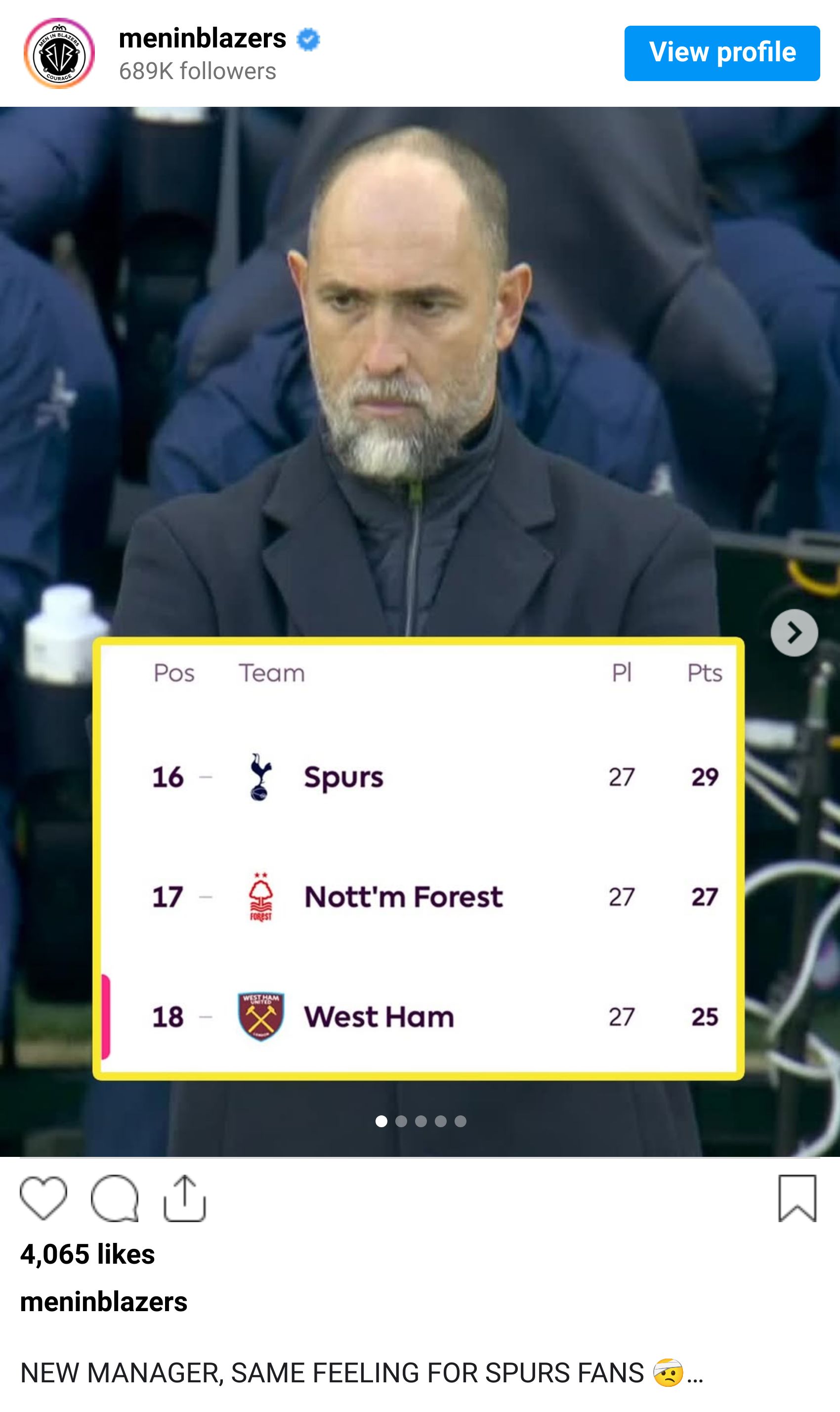
Even if West Ham can claim a full 15 points, Spurs would not be the primary victim; that honor would fall to Forest. Of all three teams, it may be Pereira’s that has the most exacting schedule. There are home games against Fulham, Burnley and Bournemouth, but little solace or succor apathy from that: Aston Villa at home, Manchester City, Chelsea and Manchester United away.
(The other side that should still be reasonably concerned with relegation, Leeds United, sits in an even more privileged position. The Premier League’s greatest sauna enthusiast, Daniel Farke, has led Leeds to 31 points so far. To get to 40 – which in all but exceptional circumstances will mean survival – his team must win three more games. Leeds still has to play Sunderland, Brentford, Wolves, Burnley and Brighton at home. From here, it would be an abject collapse for Leeds to succumb.)
To boil all of this down, then: for Spurs to be relegated, both Nottingham Forest and West Ham would not only have to perform at a level and pick up points at a speed that has eluded them for months, despite the best efforts of six managers combined. They have won 13 games between them all season; they would, at a minimum, have to win 10 in as many weeks. One might rise to the occasion. The chances of both doing it are slim indeed.
That is the good news. Let’s do the bad.
Tottenham Hotspur has won two of its last 18 league games. Nobody in the Premier League is in worse form. Nobody in the Premier League has conceded more goals since early December. Spurs have won two Premier League home games all season, against Burnley and Brentford. Since November 2024, the club has won a grand total of five times on home turf in the league. There is precious little recent evidence that Spurs are capable of winning even the four relatively gentle home games that remain; the Tottenham Hotspur Stadium might, at this point, be less an advantage and more a trap.
That could – at a push – be spun into a positive. Maybe it will be Spurs’ away record that saves them; maybe once they are free of the pressure and the expectation of their own, long-suffering fans, the players will be able to perform at something much closer to their actual level. And that would, of course, be very much in keeping with the zeitgeist of the current Premier League, where what should happen and what does happen are now mutually exclusive.
The problem is that the same logic applies to everyone else. The chaos of this iteration of the Premier League – the competitive balance, the fine margins, the prominence of set-pieces – means almost every fixture is in play. West Ham could win at Anfield this weekend. Forest could take points at Chelsea, or at home to Newcastle. The old certainties, or at least the old likelihoods, do not really apply.
Both teams, certainly, have a little more momentum than Spurs. They do not have quite such extensive injury lists. They have, thanks to more recent exposure, a greater tolerance for the stresses and strains of the relegation battle; the same, it is probably fair to say, goes for their fans. West Ham and Forest are likely to be galvanized by the threat of going down; for Spurs, there is a chance it descends into bitterness and vitriol.
They also do not have to think about Europe. Tudor spoke, after the North London derby, about Spurs and Arsenal existing in “two worlds,” distinct and separate. It is a feeling he may have to get used to.
Next month, he will have to prepare for the second leg of a Champions League last 16 tie against either Atlético Madrid or Galatasaray. Regardless of the opponent, it will be a red-letter sort of a day, a chance for Spurs to be seen as they would like to see themselves, as a European force, a club to be taken seriously. Four days later, he will be getting his players ready to face Forest, on hostile home turf, for a game that may decide whether Spurs should be thinking about the good news, or the bad.
📬 Enjoying the Correspondent? Check out our other MiB newsletters:
🐦⬛ The Raven: Our thrice-weekly newsletter where we preview the biggest matches around the world (and tell you where/how to watch them) and recap our favorite football moments from throughout the week.
☀️ The Women’s Game: Everything you need to know about women’s soccer, sent straight to your inbox every Tuesday.
🇺🇸 USMNT Only: Your regular update on the most important topics in the U.S. men’s game, all leading up to this summer’s World Cup.
Show of Strength 🏆
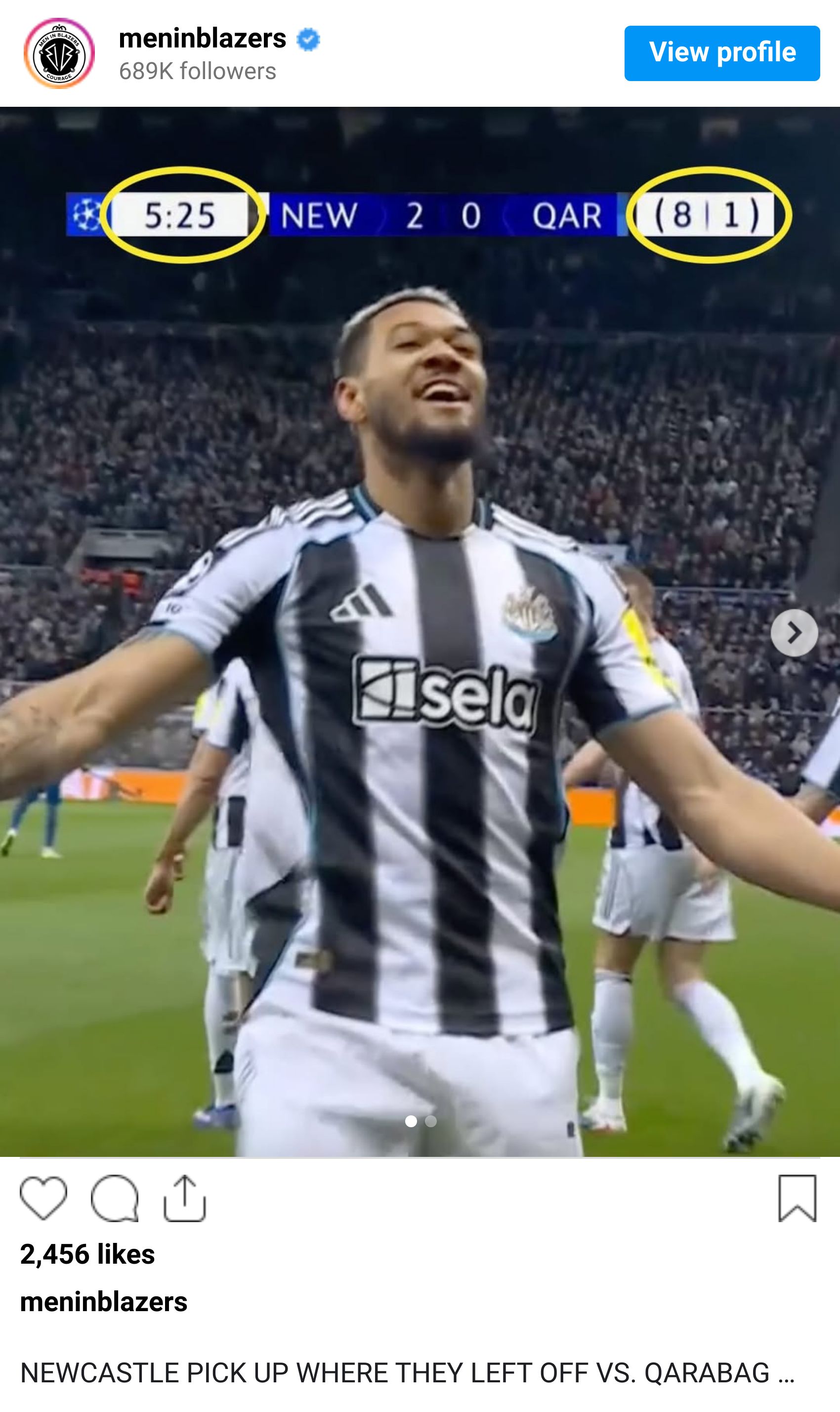
Bodø/Glimt might have made it through to the last 16 of the Champions League, but Europe’s other feel-good story did not: Qarabağ at least managed to regain some lost honor in the second leg of their elimination round tie with Newcastle, losing 3-2 at St. James’s Park. The Azerbaijani side lost 9-3 on aggregate, but let’s not mention that.
The stately progression of Eddie Howe’s team means all of England’s representatives have made it through; there will, as anticipated, be six Premier League teams in the last 16 of the Champions League. That is, math fans, a whole 37.5% of the lineup. As an indication of where the power lies in European football, it is fairly stark.
Whether it is a good thing or not is a different matter. It feels to me like the strength of the Premier League is an increasingly credible threat to the luster of the Champions League: it may be an oversimplification, but if most of the best teams in Europe play in the same domestic tournament, would that not logically be the most prestigious competition around? Would the Champions League not fade into second?
For those of us who feel that Europe needs a little diversity, there is short-term hope: Newcastle could draw Chelsea in the last 16; Arsenal and Manchester City might collide in the quarterfinals. It is not impossible that Atlético Madrid could not knock out either Liverpool or Spurs.
And besides: the intensity of the Premier League seems to exhaust its European contingent; England has provided just three of the last 13 European champions. But the long-term direction of travel is clear. England will have at least five and quite possibly six teams in the Champions League next season, too. Only four continental sides – at most – offer any real resistance. Football’s horizons are drawing in; and with it, the light is fading just a little.
This Week on the MiB Pod 🎙️
Rog and Rory break down Arsenal's 4–1 demolition of Tottenham in the North London derby and what it means for the Premier League title race. They also dive into the ripple effects across the Premier League as the pressure mounts at the top, with Manchester City tightening the screws and Liverpool pulling off yet another late winner. Plus, the Igor Tudor era begins at Spurs. Is this finally a reset… or could relegation actually be a reality for Tottenham?
Reading Material 💻
The secrets of maintaining the perfect Premier League pitch.
The club with the most famous musical fans: not the one you’d guess.
I did some political reporting.
Theory meets reality for one of Britain’s most annoying populists.
An unlikely football hero arises in Afghanistan.
The Watchlist 📺
I feel I’m probably pushing my luck telling you to watch Scottish football, but there’s an Old Firm – or Glasgow derby, depending on who you support – game this weekend, and both Rangers and Celtic really have to win (Sunday, 7 a.m. ET, Paramount+). It won’t be in the slightest bit pretty, but it will be compelling. And both clubs’ fans have been doing a fine job with celebrations recently.
There are marquee fixtures in Germany and France, too, if that doesn’t quite meet the must-watch bar for you: Borussia Dortmund hosts a rampant Bayern Munich in the biggest game in German football (Saturday, 12:30 p.m. ET, ESPN+), while Marseille – now back in the comforting grip of outright crisis – faces Lyon knowing that only one of them can realistically qualify for next season’s Champions League (Sunday, 2:45 p.m. ET, Fubo).
Correspondents Write In ✍️
A commendable degree of self-awareness arrived in the inbox a couple of weeks ago from Steve Toniatti, following up on the explanation for how the Premier League came to its position of financial – and maybe sporting – dominance.
While reading the excellent “The Club,” Steve said, he was “amazed to learn how in 1990 or so, [Rupert] Murdoch and co designed this new business model to appeal to – among others – American twenty-somethings who studied abroad in Europe, had an appreciation for European culture, and wanted to identify with something more counter-cultural than NFL, NBA or MLB fandom. I was 10 years old at the time of the decision and, to give them credit, they could not have predicted my 25-year-old self more perfectly.”
Andrew Lisi, meanwhile, has correctly identified a shortcut to getting an email published, by starting it with some praise for a piece I wrote several years ago (from Buenos Aires, ahead of the Superclásico Copa Libertadores final). This appeals to my ego and genuinely does work every single time.
Anyway, Andrew enjoyed those pieces (there were several) because they cast a light, however brief, on a corner of the football world away from “the dominance and money and excess of English football,” and helped “amplify our understanding” of the teams and cultures and places involved. He would like, he said, to “see where football and football fandom is thriving elsewhere.”
Those are the things I like doing most, Andrew, if I’m completely honest: I’m at my happiest, professionally, when I’m reporting a story that I knew nothing about. As with Bodø, they’re also really important: there’s something intriguing and uplifting about unheralded teams doing unexpected things; football’s sense of universality and wonder is crucial to its success.
It’s one of the reasons that I’ve tried to mention Hearts so much this season; that is such a stirring possibility that it would be a shame to overlook it. But there’s another that has captured my imagination: FC Thun was promoted to the Swiss top flight last season and is currently top by an astonishing 14 points. That’s the sort of achievement that really should not go unnoticed.
That’s all for this week – if you have romantic stories from far-flung corners of the football world, then I’d be delighted if you sent them to [email protected]. All other suggestions, ideas and questions are welcome, too. We do really appreciate them all.
Have a great weekend,
Rory
🙌 If you’re enjoying The Correspondent, we’d love an assist. Forward this email or share this URL with a friend, family member, or fellow football fan.
📧 First time with us? Sign up here to get Rory’s next newsletter sent straight to your inbox, and be sure to check out our other newsletters too.
👋 As always, you can send any feedback, thoughts, or odes to Terry’s Chocolate Oranges to [email protected].