Greetings from Yorkshire!
A confession: when I suggested last week that 2026 was maybe going to be one of those years, I was hoping to be proven wrong. Ideally, I wanted Manchester United and Chelsea firing their coaches to be the only thing that happened for all of January and quite a lot of February. I did not want Real Madrid to follow suit. Or one of those VAR controversies that dominates the discourse for weeks, even though the actual decision at the heart of it was, well, right.
Still, at least this week has brought us at least one story that we can all welcome. This has been a good year or so for the FA Cup. Crystal Palace winning it last May was invigorating, a reminder that these trophies all mean what we want them to mean: if we think they’re important, then they are.
What happened at Moss Rose on Saturday was no less wondrous: not just for Macclesfield and its players, now the executors of the greatest giant-killing in the tournament’s long history, but for all of those teams, and all of those towns, who dream of a moment like that. It is a terrible cliché, but there has always been something magical about the FA Cup. It sometimes feels as if it has diminished. But it never really disappears, and that is a powerful antidote to some of the less appealing aspects of the game.


This Is Us 🇪🇸

The strange thing, in hindsight, is that Xabi Alonso thought he could be different. That the most promising coach in European football, the great standard-bearer for a new generation, on some level must have convinced himself that they would have the nerve to go through with it, that Real Madrid was ready – and able – to change.
That was, even at the time, the one asterisk. In every other way, Real’s decision to hire Alonso in June last year made perfect sense. He had spent the previous two seasons cutting his teeth at Bayer Leverkusen, to fairly spectacular effect. In his first full campaign, he had not only won the club’s maiden Bundesliga title, but added the German Cup for good measure. More impressively still, he had done both without so much as losing a game; Leverkusen’s first and only defeat that year came in the final fixture, the Europa League final against Atalanta.
He had not only the credentials, then, but the references, too. He had learned at the knee of the finest coaches of the 21st century: Pep Guardiola, Rafael Benítez, Carlo Ancelotti and José Mourinho. Those last two, from Real’s perspective, were especially significant; Alonso looked, in many ways, like the heir to their throne.
Just as importantly, he had the goodwill. Alonso spent five years as a player in Madrid, winning both La Liga and the Champions League. He played more games for Real than any of the other clubs he represented during his illustrious career. Though he grew up supporting Real Sociedad and his children are Liverpool fans, Real may well be the club that defined him.
All of that was of particular importance, given the mission it appeared he had been handed. Alonso’s hiring represented a significant philosophical shift at Real: he was, after all, a cutting edge systems coach being brought in to a club that had always – or at least for a substantial part of living memory, ever since it has become Florentino Pérez’s personal fiefdom – prioritized the individual.
Alonso is far too bright not to have known that this represented a considerable risk. As much as the appointment made sense in innumerable ways, that tension felt inherent, unignorable, at least from the outside. His challenge was always going to be more complex than finding a system that worked for his squad. It was going to be convincing his players, and his employers, that they needed a system in the first place.
Whether it worked or not is a fairly simple QED. Alonso was dismissed this week, having lost the Spanish Super Cup final to Barcelona, after just eight months in charge. His team currently sits second in La Liga and should qualify automatically for the last 16 of the Champions League.
Even by Real Madrid’s high standards, the grounds for his firing feel quite shallow, particularly given that he was replaced by Alvaro Árbeloa, his former teammate at both Liverpool and Madrid, who has spent the last few years coaching a number of the club’s youth teams. Árbeloa duly lost his first game, 3-2, in the Copa del Rey, to an Albacete side struggling in the Spanish second tier. This does not currently seem like it is part of a well-considered plan.
The primary justification, as it always is at Madrid, was results. Alonso’s were not good enough; they were certainly not good enough to tolerate his eroding relationship with at least one of Real’s crown jewels, Vinícius Junior. (Another, Jude Bellingham, has made it clear that he was very much not part of the problem.) Six defeats in 34 games may not sound like a lot, but it is six more setbacks than Pérez has ever really been prepared to tolerate.

What that means, of course, is that the change Alonso was brought in to oversee can never really happen. Even with the talent available to Madrid, the introduction of a system will always involve a little learning period, a little volatility, perhaps even a little pain. It will, most likely, require some individuals to bend to the needs of the team. Real Madrid, institutionally, is not prepared to go through with that.
And that creates a bit of a problem. That the club appointed Alonso in the first place is an indication that, somewhere in Real’s hierarchy, there is an awareness that they face a considerable challenge. The club has always believed that individual talent will win out, that as long as Real’s players are better than everyone else’s, then it will remain safely ensconced at the game’s summit.
And, for the most part, it has been right. Real has won the Champions League six times in the last 12 years. Only AC Milan has won more in their entire history. Even as the idea of manager as avatar of a philosophy has taken root across the game, Real has stood as a glorious exception. Their approach might not fit with best practice. It might, in many ways, not make sense. But it does work.
Real knows, though, that the wealth of the Premier League – as well as the rise of Paris St-Germain – means that the landscape has shifted, and it is not in Madrid’s favor. Look at the run of Champions League wins again: six in 12 years, yes, but only two since 2018. Its unquestioned primacy is faltering. Its squad is no longer obviously the best in Europe. PSG may have more stardust. Arsenal and Manchester City may have more depth.
For a club that defines itself by winning, that is an issue. Winning – winning in the way that is meaningful to Pérez, winning frequently and winning sustainably – is becoming more difficult. Not impossible, by any means, but more difficult. It is not the only club that can look to a moment of individual inspiration any more; it cannot rely on its sheer weight of talent.
It needs, then, what Alonso promised: a system, a framework, an idea. If not, it faces descending into a sort of semi-permanent crisis. As Árbeloa said in his introductory press conference, Real is defined by winning. But that means that when the winning stops, it loses more than just trophies; it loses its identity. Real knows that has to change. What became clear this week, as the club waved goodbye to Alonso, is that it does not know how to do it.
The Worst of Modern Football 👎

A week or so on, there’s no point relitigating the incident between Gabriel Martinelli and Conor Bradley that cast a pall over Liverpool’s draw with Arsenal. Arne Slot, the Liverpool manager, commendably tried to cool tensions immediately after the game; the Brazilian duly apologized for his actions both privately and then publicly.
But there was one aspect of that unedifying moment that was, I think, ignored. In the heat of battle, as he acknowledged, Martinelli clearly felt Bradley was play-acting. But so did the vast majority of the crowd at the Emirates, at least some of whom booed the full-back while he was on the floor, long after it had become clear that he was in actual physical pain.
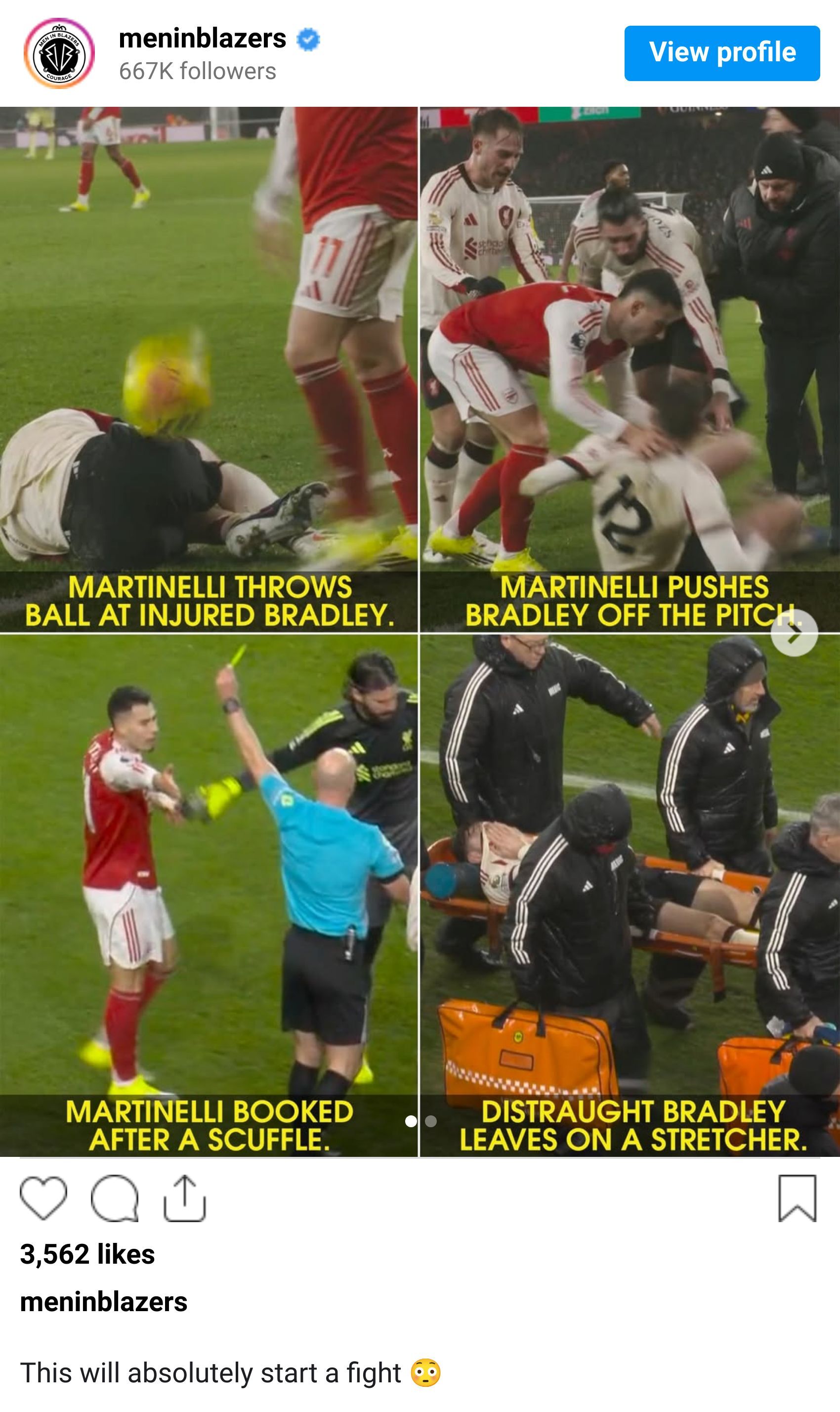
As an encapsulation of modern football, I found it an intensely sad moment. It is a tribal sport, obviously. We all get caught up in the moment. But I have been to dozens – maybe hundreds – of games where players are applauded as they are carried off injured: an expression of sympathy, respect and solidarity that transcends the jersey they are wearing.
It says a lot that the instinctive response of so many to seeing a player on the floor is to assume that he is faking; it says even more that their reaction does not soften as medical staff rush on to the field and treat him, as a stretcher is summoned, as he is mounted on to it. Writing this feels pompous, but it’s my newsletter so I’ll stick with it: all of us, not just Martinelli, really should do better.
This Week on the MiB Pod 🎙️
Rog and Rory recap a wild FA Cup weekend where we saw the biggest upset in FA Cup history. They discuss how Macclesfield shocked cup holders Crystal Palace, Wrexham's surprise win over Nottingham Forest, and what clubs like Tottenham and Manchester United can do now that they're knocked out.
📬 Enjoying The Correspondent? Check Out Our Other MiB Newsletters:
🐦⬛ The Raven: Our Monday and Friday newsletter where we preview the biggest matches around the world (and tell you where/how to watch them) and recap our favorite football moments from the weekend.
☀️ The Women’s Game: Everything you need to know about women’s soccer, sent straight to your inbox each week.
🇺🇸 USMNT Only: Your regular update on the most important topics in the U.S. men’s game, all leading up to this year’s World Cup.
Reading Material 💻
Nobody gets to be a manager any more.
More on the madness of Real Madrid.
The magic of the cup.
I went sort of viral criticizing multi-club ownership, so I wrote this to explain it.
An extraordinary story that just so happens to be set in Leeds.
The Watchlist 📺
I’m torn this week. The most compelling game in the Premier League is, I think, the obvious one: the Manchester derby, featuring a City team that has little or no room for error in the title race visiting a United side under the auspices of Michael Carrick for the first time. Well, sort of. This is Carrick’s second spell as an interim manager. It is, though, his first as a permanent interim, rather than a temporary interim, which is what he was previously, like Darren Fletcher. Sometimes I think Manchester United is not a very well-run club.
There’s also something intriguing about West Ham’s trip to Tottenham. These may be the two least happy clubs in the Premier League, which is astonishing, because the Premier League also includes Wolves. Both are waiting for the inevitable: relegation, in West Ham’s case, and the unfortunate dismissal of Thomas Frank, in Tottenham’s.
Just as decisive as either is the highlight of the Women’s Super League’s weekend, Chelsea against Arsenal. Both are trailing a revitalized Manchester City in the table, and that means both are teetering on the edge of crisis, given their high standards. This one might be the winner, in fact, on the grounds that it will include two actually competent teams.
Correspondents Write In ✍️
Well, that’s the festive lull finished: I asked for emails in last week’s edition, and you provided them in droves. Please do keep them coming – [email protected] – with any sort of query, quibble, idea or thought you might have had and wish to share.
For example, Andrea Webb Reilly: “I just wanted to whisper to someone, as a Forest fan, that I secretly wish Nuno would return, even though I know it won’t happen or wouldn’t work. It’s a bit like wishing that your Mum and Dad would get back together.”
Firstly, as an aside: the comparison here reminded me of what may well be the best bit of broadcasting anyone has ever produced, courtesy of Mark Goldbridge. (It’s NSFW and I do not endorse some of his language, but still.) And secondly: you may not be the only Forest fan with regrets; indeed, if the suggestions that Edu has not won that many admirers for his recruitment work are true, it would be tempting to suggest that Nuno really shouldn’t have left in the first place.
Jacob Woodbury, meanwhile, is struggling with a different managerial conundrum. “What exactly might it take for Thomas Frank to get sacked,” he asked.
Now, admittedly, there’s every chance he has been fired in the time between me writing this bit of the newsletter and you reading it, but assuming he hasn’t: I don’t know how you would begin to solve the riddle of this modern iteration of Spurs. I am pretty sure that firing Frank now is not the answer, but it’s also an essentially untenable situation long-term.
It may be that he can hold on simply by not losing multiple games in a row, but all that does is stave off the inevitable. Or is it better to have him in place on the grounds that quite who would replace him is not clear? I think this may be better discussed at rather more length, if I’m honest. Leave it with me.
That’s all for this week. Thanks so much for reading. I’m at Michael Carrick’s return this weekend, but whatever you’re watching, and wherever it’s from, have a great weekend.
Take care,
Rory
🙌 If you’re enjoying The Correspondent, we’d love an assist. Forward this email or share this URL with a friend.
📧 First time with us? Sign up here to get Rory’s next newsletter sent straight to your inbox.
🔍 As always, you can send any feedback, thoughts, or odes to Terry’s Chocolate Oranges to [email protected].